Overview
Metro Atlanta is one of the largest and fastest-growing data center markets in North America. In mid-2026 CBRE counted about 1,800 MW of operating inventory. It also counted more capacity under construction than in Northern Virginia. The market began in downtown carrier hotels and grew into wholesale campuses west and north of the city. Hyperscale and AI campuses now spread across the outer counties on every side.
History
Atlanta's data center market grew from its downtown carrier hotels. Telx bought 56 Marietta Street in 2004 and built its meet-me room into the region's main interconnection point. Digital Realty acquired Telx in 2015, and the exchange there now runs as DRIX-ATL. The 55 Marietta Street tower across the road and 180 Peachtree became the other core carrier buildings.
Wholesale and enterprise capacity followed in the 2000s. QTS bought its Suwanee site in 2005 and its Atlanta-Metro building on Jefferson Street in 2006. Google opened its Douglas County data center in 2007. Equinix entered the market in 2010 when it bought Switch and Data. Switch began building The Keep in Douglas County in 2017 and opened it in 2020.
Georgia created a sales tax exemption for data center equipment in 2018. The same year, Meta announced its Stanton Springs campus east of the city. QTS bought 615 acres in Fayetteville in 2022 for a large multi-building campus. In 2024 Atlanta led North America in net absorption for the first time. AWS announced at least $11 billion of investment in Butts and Douglas counties in January 2025. That November, Microsoft unveiled an Atlanta site in its Fairwater AI network.
The Market Today
Downtown and Midtown hold the interconnection core. Digital Realty runs 56 Marietta and 250 Williams. Equinix, CoreSite, DataBank, H5 and Evocative operate nearby. West Midtown adds QTS Atlanta-Metro, Edged, more DataBank sites and EdgeConneX.
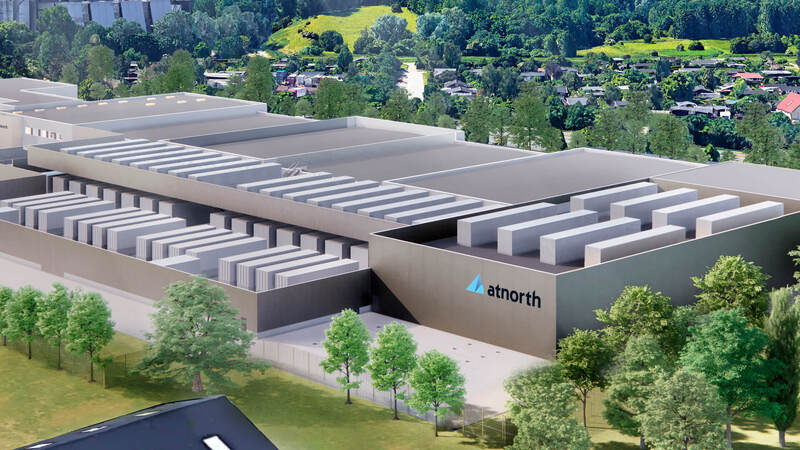
Douglas County, west of the city, is the largest wholesale and hyperscale cluster. Google, Switch, STACK, T5, DC BLOX, Flexential and Csquare all operate there, and Microsoft and AWS are building. Alpharetta, Suwanee and Norcross to the north hold a dense mix of colocation and enterprise sites. South Fulton holds Microsoft campuses at East Point, Palmetto and Union City. QTS runs its large campus in Fayetteville.
The outer ring carries the largest plans. Meta runs its Stanton Springs campus along Interstate 20 to the east. Developers have entitled several more campuses around nearby Social Circle. Gigawatt-scale projects are planned in Bartow County to the northwest and in Butts and Henry counties to the south. Vacancy fell below 2% in 2026, and most new space is preleased before it is finished.
Advantages
-
Reliable grid. Georgia Power's grid is reliable enough that Microsoft runs its Atlanta AI fleet without on-site backup generation. The downtown carrier hotels sit on Georgia Power's underground network.
-
Power prices. Georgia's average industrial power price was about 8.7 cents per kWh in 2026, below the US average. A large new load outside city limits can choose between Georgia Power and an electric cooperative.
-
Tax exemption. Georgia exempts qualifying data center equipment from state and local sales tax through 2031. County development authorities also grant property tax abatements.
-
Interconnection. Three internet exchanges serve the metro, led by DRIX-ATL with about 145 networks. Atlanta is the main carrier hub of the Southeast.
-
Land. The outer counties offer large tracts near transmission lines, suited to multi-building campuses.
-
Low storm risk. Hurricane and earthquake risk is low. Tornadoes and ice storms are the main natural hazards.
Challenges
-
Grid capacity. Georgia Power reported 12,400 MW of committed large-load customers in early 2026 and a pipeline of about 76 GW. New generation and transmission must come first, so the utility sets the delivery pace.
-
Power bills. In 2025 the Georgia Public Service Commission (PSC) let Georgia Power bill new loads over 100 MW on special terms. Voters then elected two Democratic commissioners in a race fought over power bills. In December 2025 the PSC certified almost 10 GW of new generation, much of it for data centers.
-
Water. Metro Atlanta has one of the smallest surface water supplies of any large US metro. Regional planners urge closed-loop cooling, and some counties ban open-loop systems.
-
Local limits. Atlanta banned data centers near the BeltLine and MARTA stations in 2024 and now requires special use permits citywide. DeKalb County's moratorium runs to March 2027. Clayton, Cherokee and Pike counties have also paused new projects.
-
Community opposition. Several counties have denied large campus rezonings since 2025, and residents have sued over approvals.
-
Land prices. Data center demand has multiplied rural land prices in a few years.
Trends
-
AI campuses. Hyperscalers and developers now plan gigawatt-scale campuses for AI training and inference. GPU cloud tenants such as Lambda and xAI already run clusters in intown buildings.
-
Moving outward. New construction is shifting from the core counties to exurban and rural counties with land and power.
-
Direct land buys. AWS, Microsoft and Google now buy large tracts directly instead of leasing from developers.
-
On-site power. Some projects pair data centers with on-site gas generation until grid service arrives. A 90 MW gas engine plant near Covington is one example.
-
New owners. Csquare listed on the New York Stock Exchange in 2026. I Squared Capital launched Saragon with Cogent's former data centers.
Power and Policy
Georgia Power, part of Southern Company, serves the City of Atlanta and most of the metro's data center load. Electric membership cooperatives such as GreyStone Power, Walton EMC and Central Georgia EMC serve parts of the suburbs, with power from Oglethorpe Power. Some sites draw from city utilities in MEAG Power member cities, such as College Park and Marietta. Under Georgia's Territorial Electric Service Act, a new load of 900 kW or more outside city limits gets a one-time choice of supplier. Georgia has no regional transmission organization, and Southern Company runs the balancing area. The elected five-member PSC regulates Georgia Power's rates.