Overview
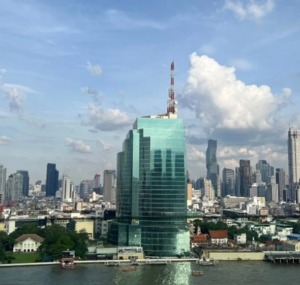
Bangkok is the centre of the data center market in Thailand, and the market reaches well beyond the city. It covers the telecom towers of central Bangkok, suburban sites in Nonthaburi, Pathum Thani and Samut Prakan, and the industrial estates of the Eastern Economic Corridor (EEC) in Chon Buri and Rayong. For two decades local telcos and internet providers served enterprise customers from city buildings. Since 2021 regional operators and hyperscale cloud providers have moved in. Most new capacity now rises on estate land southeast of the capital.
History
The market grew out of the state telcos and the first internet providers. Internet Thailand (INET) opened data centers in Bangkok towers and later at Saraburi. TCC Technology and True IDC followed in the early 2000s. CAT Telecom's national exchange became TH-IX, and the THNIC Foundation launched the neutral BKNIX exchange in February 2015. In January 2021 TOT and CAT Telecom merged into National Telecom (NT), which kept the NT Bangrak tower and the Nonthaburi campus.
Foreign operators arrived from 2015. NTT opened its second Bangkok data center at Amata Nakorn in December 2015. SUPERNAP Thailand opened in a Chon Buri industrial estate in late 2017. STT GDC, in a joint venture with Frasers Property Thailand, opened STT Bangkok 1 in Hua Mak in September 2021. Etix Everywhere bought a majority of Genesis Data Center in Bang Phli in 2022, and Telehouse opened in the Rama 9 district in May 2023.
The hyperscale era began in 2022. Gulf, Singtel and AIS formed the GSA joint venture that year, and AIS bought the 3BB broadband business in 2023. AWS launched its Asia Pacific (Thailand) region in January 2025. China Mobile bought SUPERNAP Thailand in March 2025 and now runs it as Data Zone. In May 2025 Global Infrastructure Partners (GIP) joined CP Group as an owner of True IDC, which now trades as Arise IDC.
The Market Today
Arise IDC, STT GDC, NTT, AIS, NT and INET run most of the operating colocation capacity. Central Bangkok holds the older carrier sites: True Tower, AIS's CW Tower, NT Bangrak, INET's towers and STT Bangkok 3 at One Bangkok. Telehouse Bangkok, TCC Technology's Bang Na site and NT Bangrak connect the most networks. North of the city, Arise and NT run sites in Muang Thong Thani and Nonthaburi, and AIS and OneAsia run campuses in Pathum Thani.
The Bang Na corridor and Samut Prakan form the eastern cluster. Arise's East Bangna campus, ETIX, Bridge and GSA's first data center operate there, and Equinix, Evolution and Empyrion are building.
The EEC carries the hyperscale pipeline. NTT and DayOne build at Amata City Chonburi. AWS runs its region from sites in Chon Buri and Rayong. Google, CloudHQ and Beijing Haoyang plan campuses nearby. Microsoft will host its Thai cloud region at GSA's second data center in Chon Buri. In Rayong, Arise, Gulf Edge and Stratus plan large campuses at the CPGC estate. Siam.AI, an NVIDIA cloud partner, runs GPU clusters inside GSA and STT facilities.
Advantages
-
Cloud regions. AWS runs a live region here, and Google and Microsoft have committed to theirs. They draw network operators and enterprise demand to the same estates.
-
Tax incentives. The Board of Investment (BOI) gives efficient data centers up to eight years of corporate income tax exemption, and five years in the EEC.
-
Estate land. Chon Buri and Rayong estates sell serviced plots with power, water and roads. WHA sold about 900 rai to a single data center buyer, its largest plot sale, with transfer in 2027.
-
Clean power options. Large users can buy certified renewable power through the Utility Green Tariff (UGT). Direct power purchases opened to all industry in July 2026.
-
Interconnection. Bangkok hosts both national exchanges, and submarine cables land at Sri Racha, close to the EEC estates.
Challenges
-
Grid capacity. Data center power requests in Thailand exceed 30,000 MW. The Electricity Generating Authority of Thailand (EGAT) plans eastern grid upgrades from 2027.
-
Project review. In September 2026 the national data center policy board paused 49 projects under construction and froze 117 pending approvals. Under the November framework, projects with permits or BOI promotion by August 14, 2026 proceed and have one year to comply.
-
Carbon intensity. Natural gas generated more than 65% of Thailand's electricity in 2025.
-
Flood risk. The 2011 floods forced the evacuation of the Nava Nakorn estate in Pathum Thani.
-
New costs. A data center electricity tariff of about THB 5 to 6 per kWh was approved in July 2026.
Trends
-
Foreign capital leads. China Mobile's purchase of SUPERNAP and GIP's stake in Arise IDC are the largest deals. Regional and global operators back most new campuses.
-
Building moves east. New capacity goes to EEC estate land rather than city towers. Data centers are forecast to make up nearly 40% of WHA and Amata land sales in 2026.
-
AI demand. GPU clouds such as Siam.AI and NIPA Cloud lease space in existing facilities. Newer campuses are designed for dense AI loads.
-
Telcos build at scale. Gulf and AIS formed Gulf Edge to build at the CPGC estate in Rayong.
Power and Policy
EGAT runs the transmission grid. The Metropolitan Electricity Authority (MEA) distributes power in Bangkok, Nonthaburi and Samut Prakan. The Provincial Electricity Authority (PEA) serves Pathum Thani, Chon Buri, Rayong and Saraburi. The Energy Regulatory Commission (ERC) sets tariffs and runs the UGT and direct power purchase schemes. The BOI grants incentives, and the national data center policy board screens new projects under the November 2026 framework.