Overview
Edmonton is a compact colocation market with a very large AI pipeline. Regional operators run a handful of small facilities inside the city for local businesses and network providers. Beyond the city limits, power plant sites and the Industrial Heartland have drawn the province's biggest data centre projects. Both projects that won grid capacity in Alberta's 2025 large-load allocation sit in the Edmonton region.
History
Edmonton's data centres began with its internet providers. CCI Networks, later The Internet Centre, started in 1993 and opened colocation on the city's south side in 2003. Wolfpaw built its downtown data centre in Rice Howard Place in 2005. Primus Canada opened an internet data centre in Edmonton City Centre in 2008.
Larger facilities followed in the 2010s. Care Factor, soon renamed Pivot Data Centres, opened a 40,000 sq ft facility in west Edmonton in 2012. Rogers bought both the Primus and Pivot data centres in 2013. IBM Canada opened its Western Leadership Data Centre in Acheson in 2014, and the facility passed to Kyndryl in 2021. Not every venture lasted: a data centre on Alexander First Nation land northwest of the city opened in 2007 and closed in 2009.
Ownership changed again in December 2025, when InfraRed Capital Partners bought Rogers' data centres to form Qu Data Centres. The AI era arrived the same year. In 2025 the grid operator gave both of its interim data-centre allocations to projects near Edmonton. In July 2026 Meta broke ground in Sturgeon County.
The Market Today
Qu Data Centres is the largest colocation operator, with EDM1 in Edmonton City Centre downtown and EDM2 in the Armstrong Industrial area. Wolfpaw's downtown facility hosts YEGIX, the Edmonton Internet Exchange, and Hurricane Electric's Edmonton node. Kyndryl runs a Tier III-design facility in Acheson, west of the city. The Internet Centre and 4WEB run smaller rooms.
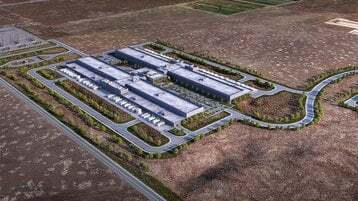
The AI build sits outside the city. Meta's campus in Sturgeon County, part of the Industrial Heartland, will draw on the new Greenlight Electricity Centre next door. Beacon Data Centers plans a gas-powered campus across the highway. West of the city, Brookfield and CPP Investments plan the Boreal Technology Hub at TransAlta's Keephills plant. TransAlta has also rezoned land at its Sundance plant. Capital Power has proposed a campus at its Genesee station but is not advancing it yet.
Advantages
-
Grid access first. Both projects in Alberta's 2025 interim large-load allocation sit in the Edmonton region. Existing high-voltage lines already serve the large power plants west of the city.
-
Power plant sites. TransAlta's Keephills and Sundance plants and Capital Power's Genesee station offer owned land beside generation and transmission.
-
Industrial Heartland. The heavy-industrial district northeast of the city already has pipelines, gas supply and industrial zoning.
-
AI talent. The University of Alberta and the Alberta Machine Intelligence Institute (Amii), one of Canada's three national AI institutes, anchor a deep research community.
-
Cold climate. Long, cold winters allow free cooling for much of the year.
Challenges
-
Thin colocation supply. Edmonton's facilities are small. None of the national colocation operators active in Calgary has a facility in the city.
-
Limited interconnection. Peering centres on a single downtown exchange, and the nearest public cloud region is in Calgary.
-
Grid queue. Beyond the two interim allocations, every new large load waits for the grid operator's second intake. That process favours projects that bring their own gas generation.
-
Community appeals. More than 100 residents appealed Meta's development permit to the Land and Property Rights Tribunal in 2026.
-
Extreme cold. Winter lows below -30°C demand cold-weather design for generators, cooling and water systems.
Trends
-
Power plants become campuses. West-side generators are rezoning land around their plants for data centres. TransAlta converted its Keephills and Sundance units from coal to gas in 2021.
-
Hyperscale arrives in the Heartland. Meta's campus and its dedicated gas plant set the pattern for very large builds northeast of the city.
-
Specialists own the colocation base. Rogers' sale to InfraRed and IBM's spin-off of Kyndryl left the city's largest facilities with specialist operators.
-
Small rooms close or move in. Older carrier rooms downtown have closed, while Wolfpaw runs suites inside Qu's larger facilities.
Power and Policy
EPCOR distributes power inside the City of Edmonton, and FortisAlberta serves most of the surrounding counties. AltaLink owns most of the transmission that serves the large campuses. The Alberta Electric System Operator (AESO) runs the grid and its connection queue, and the Alberta Utilities Commission (AUC) approves power plants and substations. The AUC approved the Greenlight Electricity Centre for Meta's campus in June 2026. Its decision on Beacon's Heartland plant is due by October 29, 2026. The Alberta page covers the province-wide rules on large loads, self-supplied power and the new data-centre levy.