Overview
Calgary is the largest data centre market in Alberta and one of the main colocation hubs in Western Canada. For two decades it served enterprise, government and energy-sector customers from downtown towers and industrial parks. Since 2023 the market has shifted toward wholesale and AI capacity north of the city, around Balzac and Airdrie. Developers now pitch large AI campuses across the surrounding counties, betting on Alberta's natural gas and open power market.
History
Calgary's data centre market grew out of its telecom carriers and its oil and gas head offices. TELUS opened its Calgary Internet Data Centre in 2001. Q9 Networks built much of the city's early commercial colocation, and Bell bought Q9 in stages from 2012. Rogers built out downtown space in the early 2010s. In 2014 it opened a facility in Airdrie that it billed as Alberta's first Tier III certified data centre. Shaw opened its own Calgary data centre in 2015.
Over the next decade the carriers sold their colocation businesses to specialist operators. Shaw sold its facility to eStruxture in 2019. Bell sold its three Calgary sites to Equinix in 2020, as part of a 13-site Canadian deal. Rogers sold its data centre business to InfraRed Capital Partners in December 2025, and the sites now run as Qu Data Centres. Cologix entered the market in October 2025 by buying DataHive's downtown carrier hotel.
Amazon Web Services opened its Canada West (Calgary) region in December 2023, the same year eStruxture opened a new facility in Balzac. Together they marked the move toward large-scale capacity outside the city core.
The Market Today
Equinix, eStruxture, Qu Data Centres and Cologix lead the colocation market. Equinix runs three facilities, one in Bankers Hall downtown and two in southeast Calgary. eStruxture runs sites in southeast Calgary and Balzac. Qu runs two facilities in central Calgary and one in Airdrie. Local operators such as Arrow Datacenters and DataHive serve smaller retail customers.
Cologix's carrier hotel at 840 7th Avenue SW anchors the city's interconnection. YYCIX, the Calgary Internet Exchange, connects networks there and at several other colocation sites.
AWS runs three Availability Zones in the Calgary area, and Amazon plans to invest C$4.3 billion in the region by 2037. eStruxture's CAL-3 in Rocky View County is the market's first large AI-ready build. CoreWeave signed as its anchor tenant in May 2026, and eStruxture targets a fall 2026 launch. Calgary-based GPU cloud providers also serve demand for Canadian-hosted AI.
Advantages
-
Power options. Alberta runs a deregulated power market. Large users can buy power directly or build their own generation, and the province has abundant, low-cost natural gas.
-
Climate. Calgary's cold, dry climate allows long free-cooling seasons, which lowers cooling energy.
-
Taxes. Alberta has no provincial sales tax, no payroll tax and a low corporate income tax rate.
-
Policy support. The province released an AI data centre strategy in December 2024. It aims to attract C$100 billion of data centre investment within five years and offers a concierge service to speed approvals.
-
Demand and land. Energy companies, government and a growing sovereign AI market need Canadian-hosted capacity. Open land with transmission and gas pipelines sits within an hour of the city.
Challenges
-
Grid access. Power delivery is the main constraint. In June 2025 the Alberta Electric System Operator (AESO) capped new large data-centre load at 1,200 MW. All of it went to two projects near Edmonton, and no Calgary-area project received an allocation.
-
Carbon intensity. Natural gas supplies most of Alberta's electricity. Buyers with clean-energy targets can find cleaner grids in British Columbia, Manitoba and Quebec.
-
Price swings. Alberta's wholesale power price moves with gas prices and demand, so unhedged costs can vary widely.
-
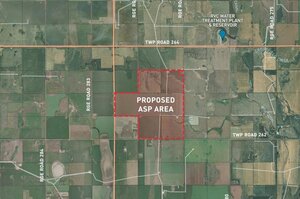
Local approvals. Rocky View County Council rejected a large AI technology park in 2025. In July 2026 it paused new data-centre rezoning applications until it adopts an emerging-sector strategy. In August 2026 the Alberta Utilities Commission (AUC) denied a gas plant for a large campus north of Calgary, citing its closeness to a community.
-
New costs. From December 31, 2026, a provincial levy applies to data centres of 75 MW or more. The levy is creditable against Alberta corporate income tax.
-
Weather. Southern Alberta sees frequent summer hailstorms, and the 2013 flood forced the evacuation of downtown Calgary.
Trends
-
Telecom carriers have left colocation. Bell, Shaw and Rogers all sold their Calgary data centres between 2019 and 2025. Specialist operators and infrastructure investors now own the market's core.
-
Demand has turned to AI. New capacity targets GPU clusters and sovereign AI rather than enterprise racks. CAL-3 and its CoreWeave lease set the pattern.
-
Developers bring their own power. The AESO's Phase 2 process favours projects that supply their own generation. Intake was set to open in fall 2026. Several campus plans now pair data halls with on-site gas plants. Beacon Data Centers' Indus hub east of Calgary went to an AUC hearing on its plant in August 2026.
-
The pipeline far exceeds the grid. By February 2026, 42 data-centre projects had asked the AESO for about 21 GW. Wheatland County approved land use for Diode Ventures' Goldfinch Technology Park in August 2026, with a first phase targeted for 2029. Most other proposals still wait on power, rezoning or both.
-
Crypto mining stays rural. Bitcoin mines run on gas-fired power at rural sites. Counties approve them case by case through land-use redesignation.
Power and Policy
The AESO runs the grid and the connection queue, and the AUC approves power plants and transmission. ENMAX Power distributes electricity inside the City of Calgary, and FortisAlberta serves most of the surrounding area. The Utilities Statutes Amendment Act, 2025 lets the province classify data centres and require load management. It also makes data centres pay for the transmission upgrades they need. Alberta plans to begin a restructured energy market in 2027.