Overview
Northwest Ohio covers Toledo and the farm counties to its south and west, from Lake Erie to the Indiana line. For decades its data centers were telephone exchanges, carrier buildings and small Toledo colocation sites. Since 2024 it has become one of the busiest hyperscale frontiers in Ohio. Three campuses now under way near Bowling Green, Lima and Van Wert dwarf everything built before. Community pushback has grown just as fast.
History
The region's first data centers served the telephone network. Ohio Bell opened its eight-story Toledo exchange in 1925, and AT&T still runs it. In 1999 Williams Communications bought a building in Toledo's Old South End for its long-haul fiber network, a site Lumen now owns.
Local colocation followed. CISP moved its Toledo data center to Moffat Road in 2000. Telesystem, the business arm of Block Communications, built DC-1 at its Toledo network center. Amplex in Luckey and Microtronix in Ottoville added small rural sites. The University of Toledo opened a green data center with natural-gas microturbines in 2013.
Hyperscale interest arrived in 2023 and 2024. An affiliate of Meta began buying farmland in Middleton Township in 2023, and site work started in 2024. Microsoft announced a site near Lima in August 2024 but dropped it two months later. MARA Holdings began building a bitcoin mining site north of Findlay in November 2024. Google bought land north of Lima in 2025, and Thor Equities assembled the Van Wert Mega Site the same year.
The Market Today
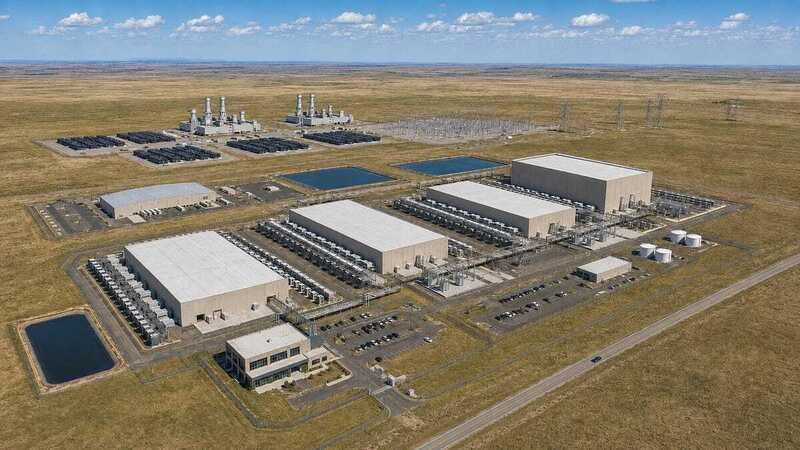
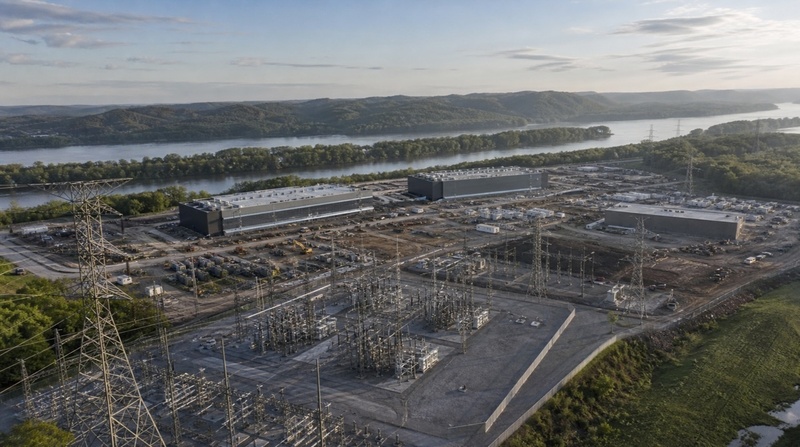
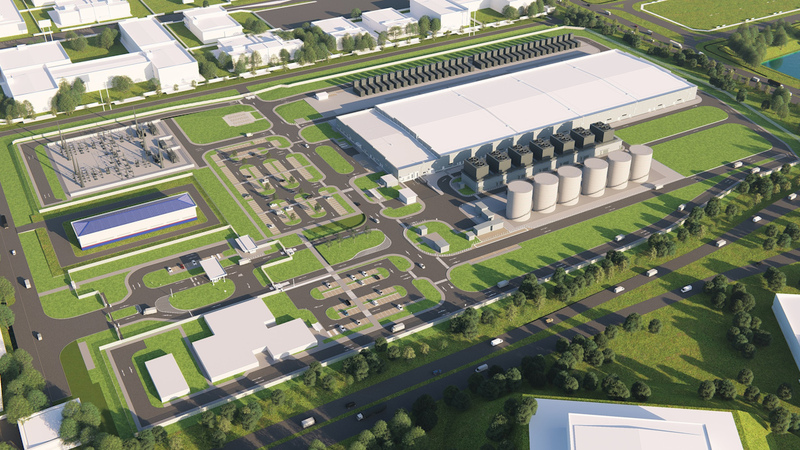
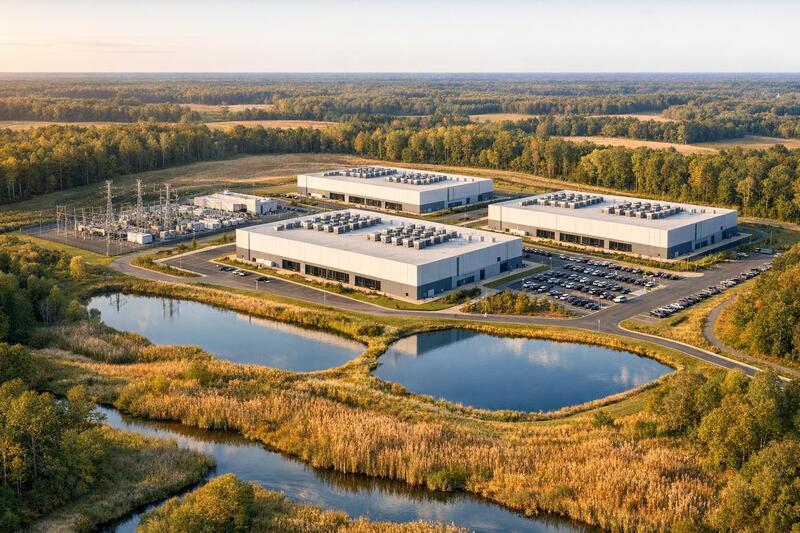
Three hyperscale campuses define the market. Meta's Bowling Green campus is the furthest along, with its first buildings rising in 2026. Google is building two buildings on North Cole Street in American Township, north of Lima. QTS bought about 900 acres at Van Wert in June 2026 and broke ground on a seven-building campus.
Toledo holds the region's colocation. CISP, Telesystem and Lumen operate there, alongside the AT&T and Verizon exchanges. Local networks peer at internet exchanges in Columbus or Detroit. Connect Data Centers opened an edge data center in Bowling Green in 2026.
MARA Holdings runs the region's only large crypto site, on wind-farm land north of Findlay. New proposals keep arriving, including QLevr in Rossford and a planned campus in Wapakoneta. Others stall: Vantage dropped its Oregon campus in November 2026 after voters capped data center size.
Advantages
-
Grid and transmission. The region sits in PJM, with 345 kV lines from both FirstEnergy and AEP Ohio crossing open farmland.
-
Natural gas. The NEXUS, Rover and Panhandle pipelines cross the region and feed behind-the-meter plants.
-
Land. Flat, cheap farmland and large industrial parks allow campuses of several hundred acres.
-
Location. Interstates 75 and 80/90 carry fiber between Chicago, Detroit, Columbus and the East Coast.
-
Local incentives. Counties have granted 15-year, 75% property tax abatements to the largest campuses.
Challenges
-
Local resistance. Lima, Findlay, Tiffin, Maumee, St. Marys and Pioneer adopted moratoria in 2026, as did several townships.
-
Voter caps. In November 2026 voters in Oregon and Defiance capped new data centers at 25 MW, and Upper Sandusky banned large ones.
-
Utility tariffs. AEP Ohio's data center tariff requires large customers to pay for at least 85% of contracted demand.
-
Grid timelines. New 345 kV substations for the Lima and Van Wert campuses will not enter service until 2028.
-
Thin interconnection. The region has no internet exchange and few carrier-neutral colocation options.
Trends
-
Hyperscale moves rural. Builders have shifted from central Ohio to Northwest Ohio farmland with high-voltage lines and gas.
-
Bring your own power. Meta's campus pairs grid service with a dedicated 350 MW gas plant that does not connect to the grid.
-
Voters set limits. Ballot measures and moratoria now decide where large data centers can go.
-
Telco real estate shifts. AT&T sold dozens of exchanges in a 2025 sale-leaseback, and Brightspeed has marketed others. Verizon will retire copper from December 2026.
Power and Policy
The region sits in the PJM Interconnection, split between FirstEnergy's Toledo Edison in the north and east and AEP Ohio in the west. Municipal systems such as Bowling Green buy power through American Municipal Power, and rural co-ops buy through Buckeye Power. The Public Utilities Commission of Ohio (PUCO) approved AEP Ohio's data center tariff in July 2025, and FirstEnergy filed its own in 2026. House Bill 15 lets behind-the-meter generation serve large customers from August 2025. The Ohio Power Siting Board (OPSB) approves generation plants of 50 MW or more.