Overview
Indiana's data center market has three parts. Indianapolis holds the state's colocation and carrier hotels. The north, from Lake County to Fort Wayne, holds most of the hyperscale build. Central and southern counties carry a newer pipeline of AI campuses and crypto mining sites. The state also straddles two grids within the Midwest US: the Midcontinent Independent System Operator (MISO) and PJM Interconnection.
History
Indianapolis's network core formed on West Henry Street. Lightnet chose the site for a fiber switch in about 1986. By the late 1990s its owners had rebuilt about a dozen buildings there for telecom use. That campus became the Indy Telcom Center, which Netrality bought in 2021. Lifeline Data Centers, founded in 2001, opened a campus in the closed Eastgate mall in 2009. Lifeline Eastgate also hosts IndyIX, the city's internet exchange.
Colocation then grew through acquisitions. Expedient entered in 2007 by buying nFrame in Carmel. Online Tech, now Otava, bought a downtown building in 2014. DataBank entered by buying LightBound, announced in December 2018. In 2019 the state created a sales and use tax exemption for qualified data centers. Digital Crossroad opened a data center in Hammond in 2020.
The hyperscale era began in 2024. Amazon Web Services announced an $11 billion campus in New Carlisle that April. Google announced a $2 billion campus in Fort Wayne the same month. Microsoft followed in June with a $1 billion campus in La Porte. It also bought about 920 acres in Granger. Meta broke ground on a $10 billion campus in Lebanon's LEAP district in February 2026.
The Market Today
Indianapolis holds most of the state's colocation. Netrality, DataBank and US Signal share the West Henry Street cluster downtown. Expedient runs a facility in Carmel, and Lifeline anchors the east side. Sabey, Metrobloks and DC Blox are developing wholesale projects inside the city. In August 2026 the city paused new data center approvals through at least 2027. Those three projects are exempt. Meta's campus in Boone County, northwest of the city, is under construction.
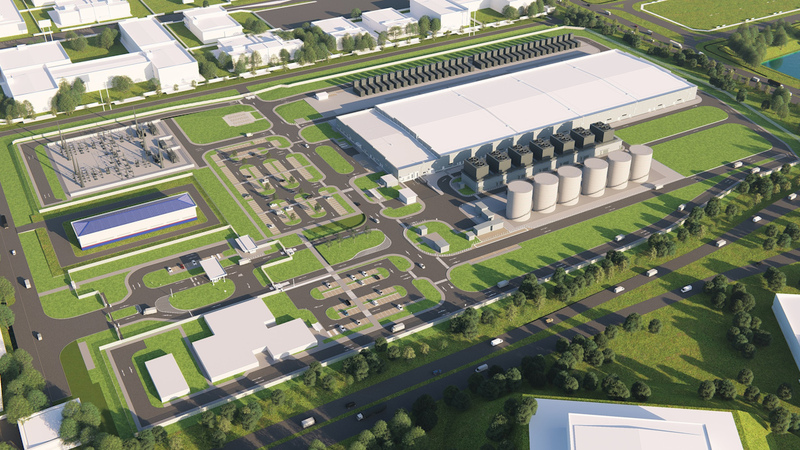
The South Bend area holds Amazon's New Carlisle campus, the state's largest hyperscale project. Its first buildings are in service, and more are under construction. Microsoft is building a second campus in Granger, northeast of Mishawaka. 1547 Critical Systems Realty and Harrison Street bought the downtown carrier hotel in 2024. Further east, Google brought its first Fort Wayne building online in December 2025.
Northwest Indiana draws on industrial land and its position on the fiber routes out of Chicago. Microsoft's La Porte campus and Amazon's Hobart campus lead the build. Digital Crossroad runs an operating data center in Hammond. Its planned second phase lost its city development agreement in mid-2026. Merrillville and Gary have both paused new approvals.
Outside the three metros, a newer pipeline is forming. Potentia and Fluidstack are building a large AI campus in Sullivan County. Crypto miners run sites in Grant and Vermillion counties. DartPoints operates an edge data center in Columbus.
Advantages
-
Tax exemption. Qualified data centers pay no state sales or use tax on equipment and electricity. The exemption runs up to 25 years, or 50 years for projects of $750 million or more.
-
Low entry thresholds. The minimum investment for the exemption ranges from $25 million to $150 million, set by county population.
-
Land. Large, flat farm and industrial parcels sit near interstates and transmission lines across the north and center of the state.
-
Two grid markets. Developers can site projects in either MISO or PJM territory, each with its own utilities and queues.
-
Utility partnerships. Northern Indiana Public Service Company (NIPSCO) formed a separate generation company to serve data center load. In 2026 Microsoft agreed to fund new generation under a 20-year deal with NIPSCO's parent, NiSource.
Challenges
-
Large-load cost rules. Indiana Michigan Power (I&M) requires loads of 70 MW or more to sign 12-year contracts. They pay for at least 80% of their contracted demand each month. A 2025 state law makes large-load customers pay at least 80% of the costs of projects built to serve them.
-
Local moratoria. More than two dozen cities and counties have paused data center approvals, including Indianapolis, Merrillville, Gary and Madison County. Marshall and Starke counties banned them.
-
Zoning risk. Google withdrew its rezoning request for a Franklin Township campus in Indianapolis in September 2025. In October 2026 a court reversed the rezoning for a planned White County campus.
-
Grid build-out. Utilities must add generation and transmission before the largest campuses can energize. Some developers plan on-site gas generation to bridge the gap.
-
Local payments. A 2026 state law requires data centers to pay local governments up to 1% of their sales tax savings.
Trends
-
Hyperscale scale-up. In November 2025 Amazon announced a $15 billion northern Indiana plan on top of New Carlisle. Microsoft and Meta have both added campuses since 2024.
-
Customer-funded generation. Hyperscalers now sign long contracts that pay for new plants. American Electric Power (AEP) and X-energy are studying a 960 MW small modular reactor plant to serve Amazon.
-
New developers. Digital Realty chose Kokomo for its first Indiana campus in October 2026. AI-focused developers are also moving into rural counties in the south and west.
-
Tighter local control. Moratoria spread through 2026, and some counties moved to outright bans. The legislature also ordered a state report on data center tax incentives.
Power and Policy
Indiana splits between two grid operators. I&M, an AEP utility, serves the northeast and north-central counties inside PJM. NIPSCO, Duke Energy Indiana, AES Indiana and CenterPoint Energy serve most other areas inside MISO, alongside rural cooperatives and municipal utilities. The Indiana Utility Regulatory Commission (IURC) approved I&M's large-load settlement in February 2025 and NIPSCO's generation company in September 2025. House Enrolled Act 1007, signed in May 2025, set large-load cost rules and fast-tracked new generation. House Enrolled Act 1210, signed in March 2026, added the local payments.