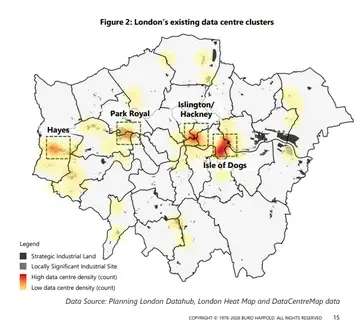

London Mayor Sadiq Khan has pledged "coordinated action" to address the challenges posed by rising data center demand across the capital, particularly growing pressure on power infrastructure. A report commissioned by the Greater London Authority and prepared by Buro Happold found that while London currently supports around 1GW of data center capacity at peak demand, requests in the grid connection queue amount to nearly 10GW. The study also identified 99 operational data centers across Greater London.
The figures exclude Slough, home to Europe’s largest data center cluster. To address growing demand, Khan plans to host a roundtable with industry stakeholders and local authorities in the coming weeks. He also wants to position London as a hub for greener data center innovation, with proposals on energy efficiency, heat reuse, and smart infrastructure set to be included in the next draft of the London Plan, due this summer.
“My ambition is clear, I want London to become the world’s leading city for environmentally friendly, low-emission, high-efficiency data center development, and AI infrastructure so that our capital remains a leading global hub for digital innovation,” said Khan. “The energy requirements of data centers are colossal, so delivering their expansion at pace alongside London’s other infrastructure needs will require more coordinated planning. Closer partnership between the private and public sector, and across all levels of government, will be vital.
“In short, the provision of electricity is critical and will only become more so in the years ahead. As a result of this reliance, when the grid can’t keep pace with demand, the consequences are immediate,” said James Small-Edwards, assembly member and chair of the committee.
“The government wants the UK to lead the way globally in artificial intelligence and digital innovation. Bold goals that, if successful, will drive huge demand for data centers, which are often staggeringly energy-intensive. But if we don’t plan ahead, we run the risk of not meeting those ambitions, or realizing those ambitions at the expense of urgently needed housing and infrastructure.”