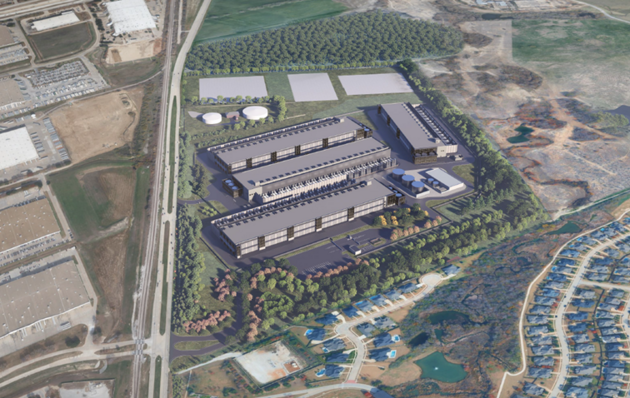
Taylor City Council voted 5-0 on Oct. 8 to approve a development agreement with Big Watt Digital and PowerHouse Data Centers for the Taylor Technology Campus, a 664-acre hyperscale project immediately east of the city that could reach one gigawatt of capacity. The joint venture announced the approval on Oct. 9. The site sits between FM 112 and U.S. 79 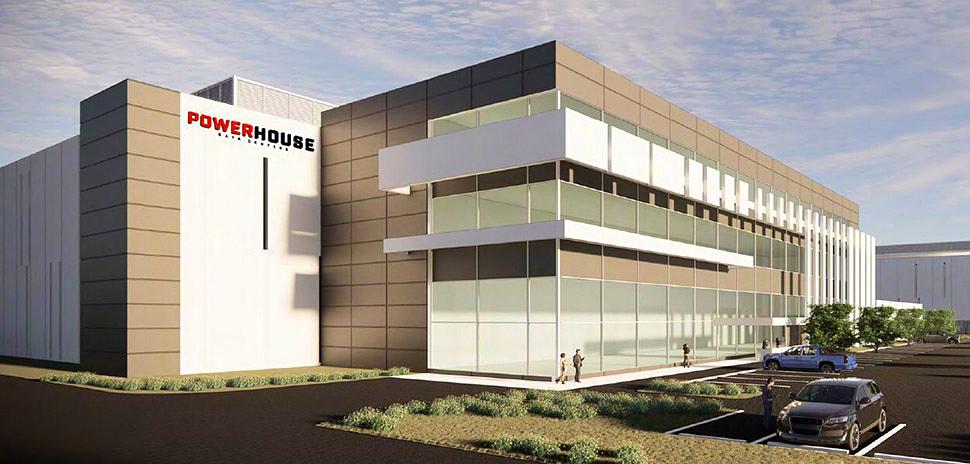 Official architectural rendering of PowerHouse Data Centers' Irving, Texas campus, showcasing their Texas hyperscale facility design.in Williamson County, in the Austin metro.
Power is the center of the deal. Big Watt builds dedicated behind-the-meter generation, and the campus is planned around on-site natural gas plants that serve the data halls directly, with surplus electricity sold back to the grid. First power is targeted for the first half of 2028, with construction running from 2027 through 2029.
How much power the city itself supplies is less clear. CRE Daily reports that Taylor will annex the site and provide 500 MW, with an option for another 500 MW. The city's own project summary says the campus will generate its own power on site and that the developers must pay for all utility lines connecting the site to city systems.
Annexation is what gives Taylor leverage. The developers first filed as Project Mustang, saw the Planning and Zoning Commission table the project for 90 days in August, then withdrew their zoning and annexation application on Sept. 3. The agreement that came back carries rules Williamson County could not impose: closed-loop cooling on reclaimed water with an initial fill of 1.575 million gallons for the whole site, noise capped at 65 dBA or the pre-development level, 300-foot setbacks, and a 400-foot landscaped buffer with six-foot berms along the south property line. The developers also agreed to drop a Texas Commission on Environmental Quality wastewater discharge permit application and to fund reclaimed-water upgrades.
The joint venture committed $28.2 million to the community, including $10.2 million for Taylor ISD programs and $1.5 million for student scholarships, and the city projects about $1.3 billion in gross tax revenue through 2046. The developers estimate 19,000 construction jobs across Williamson County.
"By pairing digital infrastructure with dedicated, behind-the-meter power, we are designing for and addressing one of the biggest constraints facing data center development today: access to reliable power without relying solely on incremental grid capacity," said Alex Hern, co-founder and co-chief executive officer of Big Watt Digital.
Local coverage of the vote tied the approval to months of neighborhood complaints about water use, noise and on-site power generation. Those are the issues the development agreement is written to address.
Behind-the-meter gas has become the fastest route to power in Texas. Reporting on the approval notes that ERCOT is tracking roughly 438,000 MW of large load requests, close to 89 percent of them data centers, while grid interconnection queues stretch years.
Baxtel tracks 99 data center sites in the Austin market, operated by 37 providers, with 28 under construction. PowerHouse Data Centers, a division of American Real Estate Partners, has 67 sites listed on Baxtel.
The Taylor vote shows what Texas developers will trade for a gigawatt. The withdrawal in September was a negotiating step, not a retreat, and the rules the partners accepted on water, noise and setbacks are stricter than anything Williamson County could have enforced. For PowerHouse, the approval extends a Texas pipeline that already includes Irving, Grand Prairie and a land bank in Uhland. Speed is the product, the regulation is the price, and the developers have now agreed to pay it.
Related on Baxtel