 on Friday announced more than C$10 billion (about US$7.1 billion) in private investment for a data center campus ...](https://cdn.baxtel.com/data-center/anthropic-signs-first-canada-lease-at-everwind-s-c-10b-nova-scotia-campus/logo/anthropic-signs-first-canada-lease-at-everwind-s-c-10b-nova-scotia-campus-featured.jpg)

Halifax-based energy developer EverWind on Friday announced more than C$10 billion (about US$7.1 billion) in private investment for a data center campus at its Point Tupper industrial site in Richmond County, Nova Scotia, and Anthropic confirmed it signed a long-term lease for the first phase, the Claude developer's first data center agreement in Canada. EverWind's announcement describes the combined package, which includes C$2 bil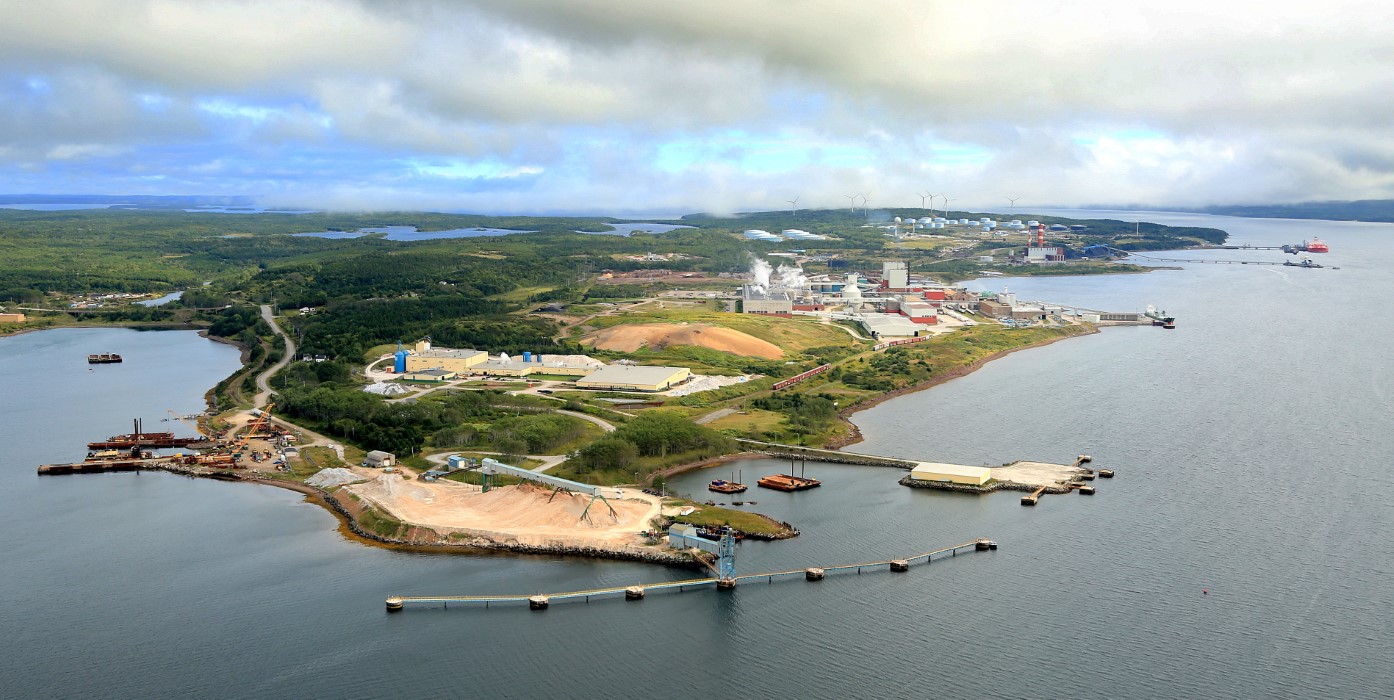 Wide aerial landscape of the Point Tupper industrial park and Strait of Canso coastline.lion for new wind generation, as the largest privately funded investment in the province's history.
The announcement confirms and sharply expands plans Baxtel first reported on October 6, when EverWind acknowledged it was exploring data center development at Point Tupper, a fuels terminal the company is converting into a green hydrogen and ammonia hub.
The campus and the lease
The campus is planned to begin with a 95 MW phase at EverWind's Point Tupper site in late 2027, followed by a 325 MW expansion targeted for 2028, subject to commercial, technical and regulatory conditions. Anthropic's lease covers the first phase, an 18,600-square-meter (200,000 sq ft) building, for a term of at least 20 years, according to The Canadian Press. Land clearing is underway and EverWind hopes to pour foundations before winter, CBC reported.
A separate C$2 billion advances four onshore wind projects in EverWind's existing portfolio: Bear Lake, Windy Ridge, Kmtnuk and Upper Afton. The company says its green hydrogen and ammonia plans at Point Tupper remain unchanged.
The build is projected to create 2,000 construction jobs and 215 permanent positions.
Power, water and the province's conditions
Power is the crux. Nova Scotia's total generating capacity is close to 3,000 MW, so a 420 MW campus is a material new load. EverWind committed to fund all connection and network upgrade costs attributable to the development, add several hundred megawatt-hours of battery storage, and design the campus to reduce or stop drawing from the grid when reliability requires.
The 325 MW expansion will not connect until required system studies and approvals are complete. The provincial system operator told CBC it reviews every new project before allowing connection; EverWind said it has been assured capacity exists for phase one.
Cooling is closed-loop: a water-glycol mixture circulates in a sealed loop and heat is rejected mainly to air, with water assist only in the hottest weather. Phase one would draw about 100,000 litres of water a day from Landrie Lake, roughly the daily use of a large shopping mall. At the planned 420 MW full build-out, average use rises to about 500,000 litres a day, which EverWind puts at roughly 1 percent of the lake's identified daily safe yield.
EverWind also signed Canada's Responsible Data Centre Development Principles and endorsed conditions set by Premier Tim Houston's government: protect ratepayers, safeguard water and deliver local benefits. A First Nations consortium led by Membertou Development Corporation is negotiating an ownership stake in the campus.
What the companies said
Both sides presented the project as a test of responsible development.
"Point Tupper has supported industry in the Strait Region for more than 50 years," said Trent Vichie, EverWind's founder and CEO. "Today's announcement represents major new investment in Nova Scotia's digital and energy infrastructure and highlights the role Nova Scotians can play in driving Canada's renewed economic ambitions."
"Our work with EverWind will help meet growing demand for Claude in Canada while bringing new clean energy onto the grid and protecting existing electricity customers," said Jacob Glick, Anthropic's head of public policy for Canada, in a statement reported by The Globe and Mail. "The people of Nova Scotia should benefit from what gets built in their community." Anthropic said the campus will power Claude models and serve growing demand from Canadian and global customers.
Anthropic's capacity push
The Point Tupper lease extends an aggressive expansion. Anthropic spent US$7.33 billion on computing and infrastructure last year, triple its 2024 figure, and is preparing a US IPO that could value it above US$2 trillion, Reuters reported.
In July, Anthropic signed a 20-year lease with TeraWulf for 401 MW of critical IT load in Kentucky, a deal expected to generate about US$19 billion in contracted revenue for the operator. In September it committed to the Western Downs Digital Park in Queensland, expected to reach 2.16 GW at peak, its first lease in Australia, according to w.media. Baxtel also tracks Anthropic's 300 MW Colossus 1 site in Memphis and its Justified Data campus in Kentucky.
Nova Scotia is a small market today. Baxtel tracks 12 facilities in the province run by 10 providers; the largest is 1 MW.
Why it matters
This is what AI infrastructure permitting looks like in 2026. A province sets conditions on rates, water and local benefit, and the developer and its tenant accept them in writing. Nova Scotia traded regulatory clarity for the largest private investment in its history, and Anthropic traded public commitments for scarce, clean-powered capacity in a cool climate.
The lease also shows frontier AI demand now reaches rural industrial ports. A fuels terminal on Cape Breton is becoming AI infrastructure because it has land, water and a path to wind power.