Top Data Center News for 30th March - 4th April, 2026
April 06, 2026
Microsoft Azure
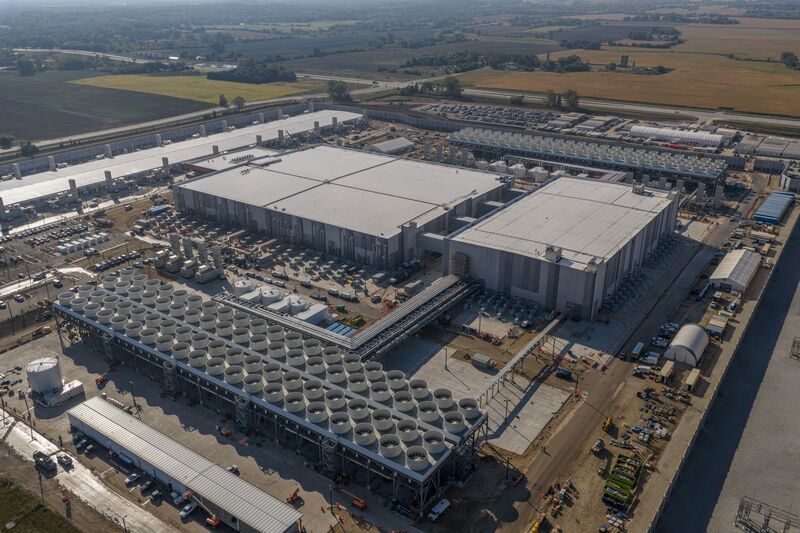
Microsoft operates a datacenter near Hortolândia’s Chácaras Recreio Alvorada area in São Paulo state. The license for the Chácaras Recreio Alvorada site was granted on July 2023.
| Distance | Site | About |
|---|---|---|
| 2.42 miles | Hyperscale Data Center Request Dataset |
Microsoft is building a datacenter in the Taquara Branca region in São Paulo state.
|
| 2.50 miles | Ascenty: Sumaré 5 |
Sumaré 5 Data Center will be part of Ascenty's Sumaré Campus in São Paulo, Brazil.
|
| 2.57 miles | Ascenty Sumaré 2 | |
| 2.57 miles | Ascenty: Sumaré 4 |
The “Sumaré 4” unit is located in a complex of five mega data centers – with capacity to expand to up to seven units.
|
| 2.62 miles | Ascenty: Sumaré 3 |
Ascenty is developing its third data center building on the Sumaré Campus in São Paulo, Brazil.
|
| 2.63 miles | Ascenty: Sumaré Campus | |
| 3.37 miles | Aurea: Sumare, Sau Paulo |
Aurea Finvest, a real estate investment and development firm, has unveiled plans for a massive 800MW data center project in Sumaré, São Paulo, Brazil.
|
| 3.74 miles | ODATA: DC SP07 |
ODATA is building a new data center facility called SP07 in Hortolândia, Brazil.
|
| 4.38 miles | IBM Brasil Hortolândia | |
| 4.74 miles | ODATA DC SP02 |
|
| 4.94 miles | Ascenty HTL3 | |
| 4.95 miles | Ascenty: Hortolândia 6 |
Ascenty is developing its sixth data center on the Hortolândia Campus in São Paulo, Brazil.
|
| 4.98 miles | Ascenty HTL2 | |
| 5.00 miles | Ascenty HTL4 | |
| 5.02 miles | Ascenty Hortolândia 5 | |
| 5.04 miles | Ascenty Hortolândia Campus | |
| 5.09 miles | Ascenty HTL1 | |
| 5.22 miles | Ascenty Campinas | |
| 7.23 miles | Ascenty Paulinia | |
| 8.00 miles | Carrier-Neutral Data Center Request Dataset |
ODATA is building a new data center facility called SP05 in Hortolândia, Brazil.
|
| 8.73 miles | Scala: SVCPCP03 | |
| 8.76 miles | Scala: SVCPCP02 | |
| 8.81 miles | Scala: Campinas SVCPCP01 |
CP01 is a telecom-made site acquired by Scala in 2021. It has a hyperscaler single-tenant building
|
| 8.81 miles | Hyperscale Data Center Request Dataset | |
| 9.53 miles | CloudHQ: Paulínia GRU Campus |
CloudHQ has begun constructing its first 200,000 sqm data center campus, GRU Technology Campus, in Paulínia, Brazil.
|
| 9.58 miles | CloudHQ: GRU 2 |
This facility will be located at CloudHQ's GRU Technology Campus in Paulínia, Brazil.
|
| 9.75 miles | CloudHQ: GRU 3 |
This facility will be located at CloudHQ's GRU Technology Campus in Paulínia, Brazil.
|
| 9.96 miles | CloudHQ: GRU 4 |
This facility will be located at CloudHQ's GRU Technology Campus in Paulínia, Brazil.
|
| 10.07 miles | CloudHQ: GRU 6 |
This facility will be located at CloudHQ's GRU Technology Campus in Paulínia, Brazil.
|
| 10.09 miles | CloudHQ: GRU 5 |
This facility will be located at CloudHQ's GRU Technology Campus in Paulínia, Brazil.
|
| 12.05 miles | TIP Brasil: Campinas |
TIP Brasil's data center in Campinas, São Paulo represents a significant R$500 million investment in Brazil's digital infrastructure.
|
Microsoft uses Containers (called ITPACs) to build out its data centers. These Containers are Shipping Containers fitted with all the necessary climate control, networking, server racks and other hardware necessary to be a “mini” data center all in one.
An Azure region is a set of data centers deployed within a latency-defined perimeter and connected through a dedicated regional low-latency network.
With more global regions than any other cloud provider, Azure gives customers the flexibility to deploy applications where they need to. Azure is generally available in 46 regions around the world, with plans announced for 8 additional regions.
An Azure geography is a discrete market, typically containing two or more regions, that preserves data residency and compliance boundaries.
Geographies allow customers with specific data-residency and compliance needs to keep their data and applications close. Geographies are fault-tolerant to withstand complete region failure through their connection to our dedicated high-capacity networking infrastructure.
Availability Zones are physically separate locations within an Azure region. Each Availability Zone is made up of one or more data centers equipped with independent power, cooling, and networking.
Availability Zones allow customers to run mission-critical applications with high availability and low-latency replication.
April 06, 2026
Microsoft Azure
April 02, 2026
Microsoft Azure
April 02, 2026
Microsoft Azure
April 01, 2026
Microsoft Azure
March 19, 2026
Microsoft Azure
Mar 12, 2026
Eric Bell
World
Feb 05, 2026
Eric Bell
World
Jan 15, 2026
Eric Bell
Applied Digital
Jan 05, 2026
Eric Bell
Dallas
Sep 04, 2025
Eric Bell
Texas