SpaceX reported second-quarter results Tuesday, its first quarterly report as a public company. One might have expected the call to focus on rockets and Starlink. But with xAI folded into the company, the call spent only about ten minutes on rockets. The rest of the call was about data center infrastructure. It's a strange turn for a rocket company, but an accurate picture of the business SpaceX is becoming.
Revenue came in at $7.8 billion, above consensus of $6.8 billion to $6.9 billion, and adjusted EBITDA nearly tripled, according to the earnings call transcript. Both were beats. Neither is the number that matters for this industry.
Capex is. SpaceX spent roughly $18.4 billion in the quarter against consensus near $13 billion. Of that, $15.8 billion went to AI compute infrastructure. The rocket division got $1.17 billion.
A launch company spent thirteen dollars on data centers for every dollar it spent on rockets.
The multiyear trajectory is more striking:
| Period | Total capex | AI capex | AI share |
|---|---|---|---|
| 2023 | $4.4B | $0.5B | 10% |
| 2024 | $11.2B | $5.6B | 50% |
| 2025 | $20.7B | $12.7B | 61% |
| Q1 2026 | $10.1B | $7.7B | 76% |
| Q2 2026 | $18.4B | $15.8B | 86% |
Three years ago, the company spent $463 million on AI infrastructure. It just spent $15.8 billion in ninety days, more than the entire prior year and thirty-four times all of 2023. In 2025, it spent more on AI than on Space and Connectivity put together.
The capex mix makes the shift unmistakable.
Because this was SpaceX's first report since its June IPO, investors had no prior public-company guidance for comparison. The company issued its first full-year revenue guidance on the call, roughly $500 million above consensus, per Fortune's coverage.
The economics behind the build
| Metric | Q2 2026 | YoY |
|---|---|---|
| Total revenue | $7.81B | +92% |
| AI segment revenue | $2.56B | +247% (+213% QoQ) |
| Connectivity revenue | $4.29B | +66% |
| Space revenue | $962M | +29% |
| Adjusted EBITDA | $3.5B | +191% |
| Net loss | $541M | improved $467M (from ~$1.0B) |
| AI segment operating loss | $1.3B | narrowed YoY; was $2.47B in Q1 2026 |
| AI segment adjusted EBITDA | +$1.1B | first positive quarter |
| Total capex | $18.4B | n/a |
| of which AI compute | ~$15.8B | 86% of capex |
| Cash and marketable securities | $100B | post-IPO + $25B senior notes |
| Backlog | $47.5B | n/a |
The AI segment turning EBITDA-positive is the quieter headline. SpaceX began monetizing Colossus through external cloud services agreements. New contracts at Colossus 1 and Colossus 2 contributed $1.6 billion of incremental revenue in the quarter. In the first few weeks of Q3, Johnsen said, the company contracted another $6.7 billion of cloud services revenue over a six-month period beginning in October.
The two anchor contracts are public and worth putting next to each other:
- Anthropic (announced May 6): $1.25 billion a month through May 2029, roughly $45 billion, for exclusive access to all of Colossus 1 and its 220,000-plus GPUs.
- Google (announced June 5): $920 million a month from October 2026 through June 2029, roughly $30 billion, for access to about 110,000 GPUs.
Johnsen's framing of the economics is the line colo operators should sit with:
"We're able to deploy capital in such a way that we're getting less than a one-year payback. It's almost like your capital is becoming almost an item that you would put otherwise in COGS," said Bret Johnsen, CFO of SpaceX.
That would put compute capital on a clock unlike the traditional 10- to 15-year stabilized-yield model for wholesale colo. But the call never defined what sits in the denominator. Whether the calculation includes the power block, cooling plant, land and financing, or only GPU cost measured against GPU revenue, determines whether these are genuinely new economics or a narrow ratio. Until that is clear, the comparison is suggestive rather than like-for-like.
The capacity ramp
CFO Bret Johnsen gave the cleanest version of the trajectory:
| Period | Nameplate compute | Change |
|---|---|---|
| Q2 2025 | 400 MW | baseline |
| Q1 2026 | 1.0 GW | +150% (3 quarters) |
| Q2 2026 | 1.4 GW | +40% QoQ, +250% YoY |
| YE 2026 (guidance) | >2 GW | ~1.4x from Q2 |
| YE 2027 (Musk, compute) | "closer to 10 GW than 5 GW" | ~7x from Q2 |
| YE 2027 (Musk, power and cooling)* | 20 GW tentative / ~15 GW realistic | see note |
The final row is not directly comparable with the compute rows. Power and cooling are deliberately built ahead of installed compute.
Installed nameplate compute increased 250% year over year. Management expects more than 2 GW by year-end and says the end-of-2027 figure will be closer to 10 GW than 5 GW.
The separate 20 GW power-and-cooling figure came under questioning from Morgan Stanley's Adam Jonas, who asked about line of sight on permitting, chips and turbines. Musk called 20 GW a tentative target and said he expects some projects to slip, leaving the company with something closer to 15 GW at the power plant level by the end of 2027.
In other words, the 15 GW estimate already assumes that roughly a quarter of the project pipeline runs late.
Because that figure measures power plant capacity rather than critical IT load, any market comparison is directional. Even so, its scale deserves context. Baxtel tracks 245 facilities in Northern Virginia, the largest data center market in the world, with 9,918 MW operational, 1,894 MW under construction and 80 MW planned. That is 9.9 GW running today and 11.9 GW across the operating and active development base.
SpaceX is proposing roughly 15 GW of power generation in eight quarters, largely outside regulated utility interconnection queues. That is one and a half times Northern Virginia's current operating capacity and more than its operating and active development base combined.
What the build strategy means for developers
The design philosophy is the opposite of how most operators sequence a build:
"Our goal is to have far more power cooling and electrical equipment than we have GPUs. That's the logical thing to do, given the relative expense of GPUs versus balance of system," Musk said.
The strategy is to overbuild the shell and power block, then fill them with silicon as it arrives. It depends on GPUs remaining the dominant cost and allocation remaining the constraint. Musk supported that thesis by pointing to memory output growing around 20% a year against demand growing 200% a year. Whether or not the exact arithmetic holds, an operator building to that thesis will chase powered land and turbines harder than racks.
Musk then made the allocation thesis explicit: "Our understanding with NVIDIA is that we will receive a very significant percentage of their GPUs next year." GPU allocation is the moat he is describing.
He also committed the roadmap to a single vendor:
"Going forward, we have decided to build exclusively on Nvidia because we think the Vera Rubin architecture is the best architecture," Musk said.
That is the most consequential sentence on the call for anyone who builds or leases halls. Standardizing a program of this scale on one vendor and one architecture narrows the thermal, power-density, rack and CDU design envelope. It removes some of the optionality operators normally hold open and concentrates the schedule risk of the buildout in a single supply chain.
The standardization goes deeper than procurement. SpaceX is reworking the NVL72 rack for both orbital and terrestrial deployment. The Starmind satellite payload is, in Musk's words, an optimized Vera Rubin NVL72 computer.
"We expect to actually deploy this on the ground as well as in orbit, because we think it's going to be a radical simplification of the normal NVL72 rack," Musk said.
That is a hyperscaler doing its own rack-level integration on Nvidia's reference design, with implications for the ODM channel.
What the call left unanswered
"Nameplate compute" was never defined, and the company did not reconcile it to critical IT load. The 15 GW figure is explicitly measured "at the power plant level," a different unit from the compute gigawatts, and the call supplied no conversion between the two. When Musk says 15 GW and a colo developer hears 15 GW, they are not talking about the same thing.
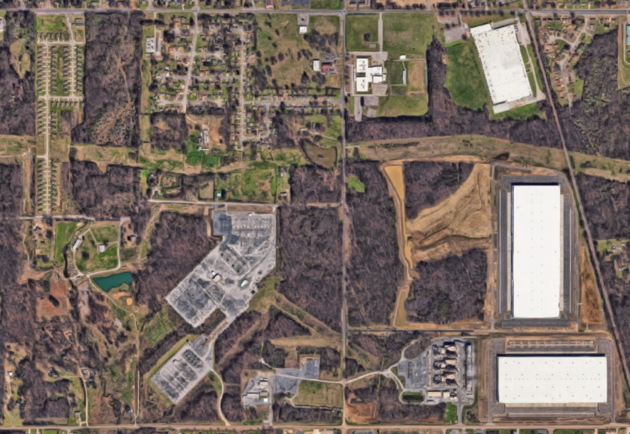
The Southaven power situation is also unresolved, and it is messier than the headlines suggest. Under an agreed order with Mississippi DEQ announced July 31, SpaceX will phase out all 69 temporary gas turbines at the Southaven, Mississippi site that powers Colossus 2. The phaseout could begin this month but will run through July 2027. The turbines are being replaced by a permanent gas plant of roughly 1.2 GW, permitted in March.
Separately, the NAACP and the Southern Environmental Law Center are suing under the Clean Air Act over 27 of those turbines. They argue that trailer-mounted units running continuously at a fixed site are stationary sources requiring preconstruction permits. A preliminary injunction hearing is expected in late August. The Justice Department has moved to intervene and dismiss, citing national and energy security.
The analyst Q&A did not address any of it. Jonas asked about turbine supply; no one asked about the turbines already on the ground. For a buildout whose speed advantage depends substantially on behind-the-meter generation and an aggressive permitting strategy, that is a material open item. The Justice Department's posture may be the more consequential signal.
Musk's monetization estimate also needs a denominator. His explicit guess of "somewhere between $30 and $50" per watt of Rubin implies $300 billion to $500 billion of revenue at 10 GW. Against a $100 billion ARR target for December, that math needs a time period he never supplied.
What to watch
- Capex: Whether spending holds near $18 billion for the next two quarters, as guided. With Q1 at roughly $10 billion, that pace would put full-year 2026 near $65 billion from a single buyer, mostly for data center infrastructure. That is the arithmetic of the guidance, not company guidance itself.
- Sites and supporting infrastructure: Baxtel tracks 14 facilities in the Memphis market, and Memphis plus Southaven cannot hold 15 GW. Texas has been mentioned, and site announcements should begin landing in the next two quarters. Water has its own schedule: the company told local officials it will resume work on the Memphis wastewater facility by Q1 2027.
- Supply chain: Nvidia exclusivity at this scale assumes both allocation and architectural leadership hold. Meanwhile, a power-ahead-of-GPUs strategy moves the physical constraint to the same turbine and transformer queues facing every other developer.
- Permitting: The late-August injunction hearing, whether the Justice Department's intervention succeeds, and whether the Southaven outcome becomes a template for projects in other markets.
Why it matters
A single buyer is adding gigawatts on a clock the rest of the industry cannot match, using behind-the-meter generation to skip the interconnection queue and a sub-twelve-month payback claim to justify a capex tempo few REIT boards would approve. That combination does not compete with wholesale colo on price. It competes on time.
The question is not only whether SpaceX can assemble 15 GW of projects. It is whether the behind-the-meter generation and permitting strategy behind that schedule survives contact with the courts. The late-August Mississippi hearing may prove more consequential to the buildout than any number management gave on the call.